The arrival of GM’s new 8.3-liter Duramax is happening at the same time as one of the largest changes to heavy-duty diesel engine oil in a decade.
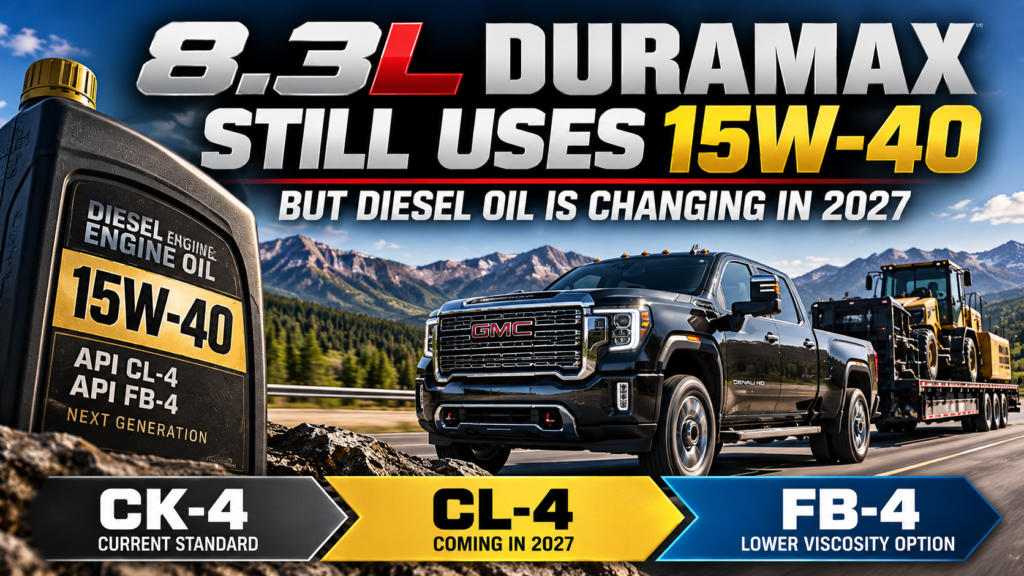
Beginning in January 2027, the diesel-oil industry will begin licensing two new API categories: CL-4 and FB-4. These replace the current CK-4 and FA-4 categories and are being developed around the requirements of a new generation of diesel engines operating under greater thermal loads and using increasingly sophisticated exhaust aftertreatment.
That timing makes the change particularly interesting for the 2027 Chevrolet Silverado HD and GMC Sierra HD.
GM has confirmed that its all-new 8.3L Duramax Turbo-Diesel V8 will produce 555 horsepower and 1,230 lb-ft of torque in the redesigned 2027 HD trucks. GM has not yet published the final oil specification for the new engine, however, so it would be premature to say the 8.3L will require CL-4 or what viscosity GM will recommend.
What we can examine is why diesel oil is changing at exactly the same time.
The Current Standard: API CK-4
For current Duramax HD owners, CK-4 is already a familiar designation.
GM’s 2026 engine-oil information specifies CJ-4 or CK-4 15W-40 for the 6.6L L5P Duramax used in Silverado HD 2500 and 3500 trucks. That is very different from GM’s 3.0L LZ0 Duramax, which uses 0W-20 meeting the company’s dexos D specification.
The distinction is important.
GM’s 3.0L Duramax belongs to the light-duty diesel-oil world centered around dexos D.
The 6.6L Duramax HD has continued using the API heavy-duty diesel-oil categories familiar throughout the truck industry.
CK-4 arrived in 2016 as the successor to CJ-4. It was developed for high-speed four-stroke diesel engines and brought improvements in areas such as oxidation resistance, aeration control and shear stability while remaining compatible with diesel particulate filters and other modern emissions equipment.
Now that specification is approaching its successor.
CK-4 Becomes CL-4
The industry development program initially known as PC-12, or Proposed Category 12, is producing the next generation of heavy-duty diesel oil.
The primary new category is API CL-4.
CL-4 succeeds CK-4 and is intended to maintain broad backward compatibility while improving performance for newer diesel engines. A second category, FB-4, succeeds FA-4 and targets engines specifically designed around lower-viscosity lubricants.
The distinction between those two categories will be important.
For most traditional heavy-duty diesel applications, CL-4 is the category owners are likely to encounter.
FB-4 represents the more specialized low-viscosity side of the new standard and should not be assumed to be appropriate for an engine unless the manufacturer specifically approves it.
Why Does Diesel Oil Need to Change Again?
Modern diesel engines place increasingly complicated demands on their lubricants.
Engine oil still has its traditional jobs: protecting bearings, piston rings, cylinder walls, valvetrain components and turbochargers while controlling deposits and carrying contaminants to the filter.
But modern diesel oil has another responsibility.
It must coexist with the exhaust aftertreatment system.
Some engine oil is inevitably consumed during normal operation. When that happens, components from the lubricant can eventually reach the exhaust.
That creates a particular problem with metallic oil additives.
The diesel particulate filter can capture both soot and noncombustible ash, but they behave very differently.
Soot can be oxidized during regeneration. Ash cannot.
Over the life of a diesel engine, ash therefore accumulates inside the DPF.
That means an oil formulation capable of protecting an engine extremely well could still create undesirable consequences downstream if its chemistry contributes excessively to ash accumulation or catalyst contamination.
The next generation of heavy-duty diesel oils is intended to address that problem more aggressively.
CL-4 Will Use a Tighter Chemical Window
One of the significant changes coming with the new categories is tighter control of lubricant chemistry.
Industry representatives involved with PC-12 have described reductions in substances including sulfated ash and phosphorus, both of which can affect exhaust aftertreatment when engine oil is consumed.
Phosphorus is particularly interesting because compounds containing phosphorus have historically played an important role in anti-wear protection.
Reducing them creates an engineering challenge.
Oil formulators cannot simply remove useful anti-wear and detergent chemistry and accept greater engine wear. They have to find different ways to provide comparable or improved protection while producing less material that can negatively affect the exhaust system.
The result is a lubricant being asked to do more with less.
The new categories are also being developed with improved oxidation resistance and wear control for engines expected to operate under increasingly demanding conditions.
Why DPF Ash Is Becoming More Important
Diesel owners are very familiar with regeneration, but regeneration only addresses part of what accumulates inside a DPF.
A regeneration event raises exhaust temperature sufficiently to oxidize accumulated soot.
Ash remains.
That means an otherwise healthy DPF gradually accumulates noncombustible material throughout its service life.
Lubricant chemistry is one contributor to that accumulation.
This helps explain why reducing sulfated ash is becoming increasingly important. The challenge is that many traditional metallic additives responsible for producing ash also perform valuable functions such as detergency, acid neutralization and wear protection.
The future of diesel oil therefore involves finding alternative chemistry capable of providing those benefits with less impact on the exhaust aftertreatment system.
The recently announced PC-12 categories were developed in part around precisely this challenge. Industry representatives have specifically identified longer DPF life and reduced aftertreatment impact as important development targets.
Heat Is Another Part of the Equation
The next generation of diesel engines is also placing greater thermal demands on engine oil.
Higher cylinder pressures, sophisticated turbocharging systems, piston cooling and greater specific output can expose lubricants to significant localized temperatures.
Oil doesn’t simply lubricate an engine.
In many areas it also carries heat away from components.
Piston cooling jets are a good example. Engine oil sprayed against the underside of a piston absorbs substantial heat before returning to the crankcase.
Turbochargers create another severe environment. Oil traveling through a turbocharger center housing must lubricate rapidly rotating components while surviving substantial heat.
Higher temperatures accelerate oxidation.
As engine oil oxidizes, its physical and chemical properties change. Excessive oxidation can contribute to viscosity changes, deposits and reduced lubricant performance.
Improved oxidation resistance is consequently another important component of the new heavy-duty diesel-oil categories.
The New 8.3L Duramax Makes the Timing Interesting
GM’s new Duramax arrives directly in the middle of this industry transition.
The 2027 Duramax increases displacement from 6.6 to 8.3 liters while producing 555 horsepower and 1,230 lb-ft of torque. GM says the new engine will be available in the 2027 Chevrolet Silverado HD and GMC Sierra HD beginning in late 2026.
That means the engine reaches customers almost simultaneously with the January 2027 introduction of CL-4 and FB-4 licensing.
That does not establish that GM will require CL-4 in the new Duramax.
As of this writing, GM has not publicly released the final 8.3L Duramax oil recommendation in the information reviewed for this article.
The current 6.6L L5P provides the useful reference point. For 2026, GM specifies CJ-4 or CK-4 15W-40 for the L5P.
The 8.3L recommendation will therefore be something worth watching closely when GM publishes the 2027 Duramax diesel supplement.
The 8.3L Duramax Retains 15W-40
One question surrounding the new 8.3L Duramax has already been answered. During GM’s presentation of the new engine, a GM engineer confirmed that it continues to use 15W-40 engine oil.
That is significant considering the broader direction of diesel engine oil development.
Some new heavy-duty engines are being designed around lower-viscosity lubricants, and the new FB-4 category will expand the industry’s ability to use XW-20 oils in applications specifically engineered for them. GM, however, has retained the traditional 15W-40 viscosity for its new 8.3L Duramax.
The more interesting unanswered question is therefore not viscosity, but oil performance category.
The current 6.6L L5P Duramax uses 15W-40 meeting CJ-4 or CK-4 requirements. At essentially the same time the new 8.3L Duramax enters production, the industry will begin licensing the new CL-4 category that succeeds CK-4.
GM has confirmed 15W-40 for the new engine, but the information reviewed for this article does not yet establish whether the production 8.3L recommendation will specifically require or reference CL-4.
That distinction will be important when GM publishes the complete 2027 Duramax diesel supplement.
More broadly, retaining 15W-40 reinforces an important point about the future of diesel engine oil: newer does not automatically mean thinner.
The next generation of lubricant technology is focused on improving oxidation resistance, wear protection and compatibility with increasingly demanding exhaust aftertreatment systems. Those improvements can be incorporated into different viscosity grades depending on how a particular engine was designed.
For GM’s new 8.3L Duramax, that engine design still calls for 15W-40.CL-4 Should Eventually Become Familiar to Existing Duramax Owners
One of the important characteristics of CL-4 is expected backward compatibility.
That means CL-4 is positioned as the eventual successor to CK-4 rather than a completely separate oil reserved exclusively for 2027 engines. Industry representatives expect CL-4 eventually to become the dominant mainstream category as CK-4 gradually leaves the market, much as CK-4 displaced earlier diesel categories.
For existing Duramax owners, that is an important distinction.
A new category appearing on store shelves does not necessarily mean older engines suddenly require a completely different lubricant strategy.
Instead, the replacement category is being designed to provide the performance needed by new engines while continuing to cover many older applications.
FB-4 requires more caution because its lower-viscosity requirements are intended for engines specifically designed and approved for them.
The Future of Heavy-Duty Diesel Oil Is Not Simply Thinner Oil
It would be easy to look at the arrival of XW-20 heavy-duty diesel oils and conclude that the industry is simply moving toward thinner lubricants.
The actual transition is considerably more complicated.
Future diesel oils are being asked to:
- withstand greater thermal stress and oxidation;
- protect increasingly powerful turbocharged engines;
- maintain wear protection with tighter limits on traditional additive chemistry;
- reduce sulfated ash and other material that can accumulate in exhaust aftertreatment;
- support longer emissions-system durability;
- and, where the engine is specifically designed for it, reduce viscosity to improve efficiency.
Some engines may benefit from lower viscosity.
Others may continue using considerably heavier oils.
The more important change is the increasing integration between engine design, lubricant chemistry and exhaust aftertreatment.
What 8.3L Duramax Owners Should Watch For
The most important information will ultimately come from GM.
When the 2027 Duramax diesel supplement becomes available, several details will deserve close attention: the required API category, recommended viscosity or viscosities, cold-temperature recommendations, oil capacity and whether GM introduces any special requirements specific to the new engine.
The current L5P uses CJ-4 or CK-4 15W-40 according to GM’s 2026 oil-capacity information.
Whether the new 8.3L follows that formula or becomes one of the first Duramax applications to take advantage of the new generation of diesel lubricants remains to be seen.
What is already clear is that the oil industry surrounding it is changing.
CL-4 and FB-4 represent more than another pair of letters on an oil container. They reflect the increasingly difficult job diesel engine oil is being asked to perform.
The lubricant must protect the engine under greater thermal and mechanical loads while simultaneously reducing its impact on a complex emissions system downstream.
For the new generation of heavy-duty diesels, engine durability and emissions-system durability are becoming increasingly interconnected — and engine oil sits directly between the two.

Leave a Reply